



Hejsan
Har ett litet problem som jag trots många tankar och funderingar inte lyckas klura ut.
Har en timer, som räknar ner från inställt värde på LED-segment. ställbar mellan 1 sek upp till 60 min. Som den är just nu är det så att när man startar nedräkningen slår den via en optokopplare på en triac för att driva en lampa. Jag har samma timer tilll min UV-låda för att belysa kretskort.
Men nu vill jag göra en för att kunna ha som timer till köket när kokar pastan, student som man ju är... Jobbigt att sitta och räkna minuterna haha.
Som sagt tidigare, när man startar timern räknar den ner på segment, och samtidigt slås triacen på så lampan tänds. Dvs går en pinne på PIC'en hög. Samma med en lysdiod, den tänds också när timern startar så vet att den är igång.
Notera att jag inte kan ändra koden till PIC'en, ej kunskapen att göra det. Sen har jag inte hela koden heller, tror jag inte iaf.
Så jag tänke mig en lösning med logik eller liknanade för att göra detta.
Jag vill att när jag startar timern så ska den ju räkna ner som vanligt, men när tiden är slut ska en summer börja tuta i några sekunder. Bara så man vet att tiden är slut. Någon som har ett tips på hur jag kan göra detta??
Alltså, jag har en pinne som blir hög, 5 volt när timern startar. När tiden är slut går den ner till 0 igen. Hur gör jag lättast för att en summer ska tuta igång i ett par sekunder med hjälp av detta??
MVH
MIcke
Hjälp med summer till timer.
Re: Hjälp med summer till timer.
Här är koden iaf. Någon som orkar kika igenom och kanske kan hjälpa mig att ändra den så att pinne 17 går hög i 5-10 sekunder, när tiden är slut???
Kan isf betala för jobbet eller något annat som önskas....
Använder 16f690 till detta: http://ww1.microchip.com/downloads/en/d ... 41262A.pdf
Kan isf betala för jobbet eller något annat som önskas....
Använder 16f690 till detta: http://ww1.microchip.com/downloads/en/d ... 41262A.pdf
Kod: Markera allt
// -----------------------------------------------------------------------
//
// Timer - Timer switch with 1 hour lamp-on-period.
// Designed for UV-lamp for photographic PCB exposure and darkroom
//
// Functional Specifications:
// - rotary encoder to select the lamp-on-period
// - button/switch to start timer function
// - 4-digit display of lamp-on-period, counting down after start
//
// -----------------------------------------------------------------------
// Summary of changes
// 1.0.7 - Uses structure for time and special update routines.
// 1.1.0 - Time maintained in binary form (in seconds), was in stucture.
// 1.1.1 - No more use of interrupt-on-change facility.
// - FOSC set to 1 MHz (was 4 MHz) for somewhat better handling of
// fast rotations of rotary encoder.
// - LED and MOC3041 now controlled by different PIC pins.
// 1.1.2 - Modified time selection algorith: more exponential.
// -----------------------------------------------------------------------
//
// Implementation notes:
//
// - DISPLAY:
// A 4 digit 7-segment display shows the time in mm:ss format.
// The 7-segment displays are multiplexed: 1 digit is on at a time.
// Multiplexing frequency 220 Hz (refresh cycle 1/55 second).
// The multiplexing is done by the interrupt routine. At every
// interrupt the next digit will be displayed. The segment patterns are
// provided by the mainline.
// When the specific PIC has a CCP module the CCP ('special event') will
// be used, otherwise Timer1 interrupt will be used for the
// multiplexing functionality.
//
// - TIME:
// Controlled via internal oscillator and Timer1.
// The timer interrupt routine sets a 'one-second' flag. The flag is
// reset by the mainline which provides the display patterns for the
// display of the new time (when the timer is in 'ON'-state).
// Time variables are stored as 4 decimal values in a structure 'mmss'
// and maintained via special functions. This prevents binary to decimal
// conversions.
//
// - SWITCHES:
// State changes of input signals are detected by a 'change-on-input'
// interrupt. The mainline decides about the appropriate action.
// All input pins are on PORTA and are debounced in the mainline.
//
// - Control of the lamp-on-period:
// Selecting the lamp-on-period is performed by a rotary encoder.
// At very first power-on the default period is 02:30, but the last
// actually used period will be remembered and become the new default
// value (stored in EEPROM at the start of the lamp-on-period).
// To reach the desired on-period quickly turning the rotary encoder
// clockwise increases the lamp-on-period, turning it counter clockwise
// decreases it. The amount varies with the current value, as follows:
// 00:00 - 01:00 1 second
// 01:00 - 02:00 2 seconds
// 02:00 - 05:00 5 seconds
// 05:00 - 10:00 10 seconds
// 10:00 - 20:00 20 seconds
// 20:00 - 60:00 30 seconds
// The timer has a maximum lamp-on-period of 1 hour, time setting wraps
// around in both directions. When set to 00:00 the timer is inactive,
// and the lamp will not switch off automatically, only manually.
// When the lamp is on it is not possible to change the lamp-on-period.
//
// - Assignments of Ports, Oscillators, Timers, and other PIC features.
// PortA is assigned to switch and rotary encoder input, except for
// pin 2, which controls the lamp.
// PortB (4 pins) is dedicated to display digit selection (multiplexed).
// PortC (8 pins) is dedicated to display segment pattern selection.
// Internal oscillator set to 1 MHz
// Timer0 not used
// Timer1 used for all timer services
// Timer2 not used (is not present in all supported chips)
// All analog functions are disabled.
//
// - Code optimization
// Since the program is relatively small (<1024 code words) only one
// code page is really used and code page switching could be disabled
// for several functions with "#pragma update_RP". When making
// changes: check if this optimisation is still allowed by removing
// these pragma statements.
//
// ----------------------------------------------------------------------
//
// This program can be used for several types of PICs.
// Supported: PIC16F631,677,685,687,689,690
// Although the differences will be minimal, for each chip a separate hex
// file will be generated.
// The target PIC must be defined on the commandline with the '-p' parameter
// (see file the makefile timer.mak for compilation details).
// ID bytes:
#pragma config ID = PGMVERSION // defined in make file
// EEPROM data
#pragma cdata[0x2100]
// compiler version info
#pragma cdata.major = (__CC5X__ / 1000)
#pragma cdata.minor = ((__CC5X__ % 1000) / 100)
#pragma cdata.minor2 = ((__CC5X__ % 100) / 10)
#pragma cdata.suffix = (__CC5X__ % 10)
// compile date and time
#pragma packedCdataStrings 0
#pragma cdata.ctime = __DATE2__
#pragma cdata.cdate = __TIME__
// #pragma cdata.chiptype = __CHIP__
// program data: default lamp_on_period
#pragma cdata.lamponlow = 150 // 2 minutes and 30 seconds
#pragma cdata.lamponhigh = 0 // (high order byte)
// ----------------------------------------------------------------------
// Common config bit settings for all supported types of PICs
#pragma config &= ~0b11.1111.1111.1111 // all config bits OFF
#if defined(_16F631) | defined(_16F677) | defined(_16F685) | \
defined(_16F687) | defined(_16F689) | defined(_16F690)
#pragma config |= 0b11.0011.1110.0100
// xxx . . . . . INTOSC, RA4,5 = I/O
// x . . . . . . WDT disabled
// x . . . . . . . PWRTE enabled
// x . . . . . . . . /MCLR = /MCLR
// x . . . . . . . . no code protection
// x . . . . . . . . . no data protection
// xx . . . . . . . . . . BOR enabled
// x . . . . . . . . . . IESO disabled
// x . . . . . . . . . . . FCMEM disabled
// xx . . . . . . . . . . . . not used
#else
#error Program does not support the specified PIC (chip)!
#endif
// ---------------------------------------------------------------------
#include <int16cxx.h> // interrupt support
#define Fosc 1000000 // oscillator frequency
#define MPXFREQ 220 // 1/55 sec for all 4 digits
#if defined(_16F685) | defined(_16F690)
#define CCP1DELAY (Fosc/4/MPXFREQ - 1) // CCP1 load value
#define CCP1DELAYLOW (CCP1DELAY % 256) // low byte value
#define CCP1DELAYHIGH (CCP1DELAY / 256) // high byte value
#else
#define TMR1DELAY (65536 - Fosc/4/MPXFREQ + 35) // TMR1 preload
#define TMR1DELAYLOW (TMR1DELAY % 256) // low byte value
#define TMR1DELAYHIGH (TMR1DELAY / 256) // high byte value
#endif
typedef bit BOOL,BOOLEAN; // boolean variable type
#define FALSE 0
#define TRUE 1
// digit configuration
#define DIGIT0 0b0001.0000 // portb.4
#define DIGIT1 0b0010.0000 // 5
#define DIGIT2 0b0100.0000 // 6
#define DIGIT3 0b1000.0000 // 7
// segment configuration
#define sega 0b0010.0000 // portc.5
#define segb 0b0001.0000 // 4
#define segc 0b0000.1000 // 3
#define segd 0b0100.0000 // 6
#define sege 0b1000.0000 // 7
#define segf 0b0000.0001 // 0
#define segg 0b0000.0010 // 1
#define segp 0b0000.0100 // 2
// global constants
static const uns8 ucSegmentPattern[10] = {
/* 0 */ sega | segb | segc | segd | sege | segf ,
/* 1 */ segb | segc ,
/* 2 */ sega | segb | segd | sege | segg,
/* 3 */ sega | segb | segc | segd | segg,
/* 4 */ segb | segc | segf | segg,
/* 5 */ sega | segc | segd | segf | segg,
/* 6 */ sega | segc | segd | sege | segf | segg,
/* 7 */ sega | segb | segc ,
/* 8 */ sega | segb | segc | segd | sege | segf | segg,
/* 9 */ sega | segb | segc | segd | segf | segg,
};
// global variables
#pragma bit ledcontrol @ PORTA.1 // LED: true=ON false=OFF
#pragma bit lampcontrol @ PORTA.2 // lamp: true=ON false=OFF
static uns8 systemstate; // 1 second tick flag
enum _syssts {STOPPED, STARTING, RUNNING, STOPPING};
static bit tick; // 1 second tick flag
static uns8 intervalsec; // counter for 1 sec ticks
static uns16 lamp_on_period; // desired lamp-on-period
static uns16 time_remaining; // remaining lamp-on-time
static uns8 digitcurrentnumber; // currently displayed digit
static uns8 digitsecondspattern; // segment pattern seconds
static uns8 digittensecondspattern; // " " ten-seconds
static uns8 digitminutespattern; // " " minutes
static uns8 digittenminutespattern; // " " ten-minutes
// local function prototypes
static void build_patterns(void); // build 7-segment patterns
static void EEPROMReadTime(void); // read time from data EEPROM
static void EEPROMWriteTime(void); // write time to data EEPROM
static void setupPIC(void); // PIC init
static void time_decrement(void); // decrement lamp-on-period
static void time_increment(void); // increment lamp-on-period
// ---------------------------------------------------------------
// Interrupt service routine
//
// Interrupt for general time management (either CCP1 or TMR1)
// - first in the interrupt handler (when using Timer1 for accuracy)
// - performs multiplexing of 7-segment displays
// - sets 1 second interval flag for handling by mainline
//
// Interrupt on change of input PortA
// - only PortA used for input
// - saves current status of PortA for handling by mainline
//
// Note: When a CCP module is available (16F685,16F690), the special event
// interrupt feature is used. This provides a somewhat higher
// accuracy in keeping time than when using a Timer1 interrupt,
// which is used otherwise.
// ------------------------------------------------------------------
#pragma origin 4
interrupt isr(void) {
int_save_registers
#pragma update_RP 0
#if defined(_16F685) | defined(_16F690) // chips with CCP module
if (CCP1IF) { // CCP1 interrupt
#else // chips without CCP module
if (T1IF) { // TMR1 interrupt
TMR1L += TMR1DELAYLOW; // )
TMR1H += Carry; // ) reload Timer1
TMR1H += TMR1DELAYHIGH; // )
#endif
if ((++intervalsec) > MPXFREQ) { // 1 second period
tick = TRUE; // set flag (reset by mainline)
intervalsec = 0; // restart counting
}
digitcurrentnumber = (++digitcurrentnumber) & 3; // next digit / wrap
// Note: a switch()/case construct takes more cycles then if / else if
PORTB = 0b0000.0000; // previous digit off
if (0 == digitcurrentnumber) {
PORTC = digitsecondspattern; // second digit
PORTB = DIGIT0; // show digit 0
}
else if (1 == digitcurrentnumber) {
PORTC = digittensecondspattern; // 10 second digit
PORTB = DIGIT1; // show digit 1
}
else if (2 == digitcurrentnumber) {
PORTC = digitminutespattern; // minute digit
PORTB = DIGIT2; // show digit 2
}
else { // otherwise (digit 3!)
PORTC = digittenminutespattern; // 10 minute digit
PORTB = DIGIT3; // show digit 3
}
#if defined(_16F685) | defined(_16F690)
CCP1IF = FALSE; // reset interrupt flag
#else
T1IF = FALSE; // reset interrupt flag
#endif
}
#pragma update_RP 1
int_restore_registers
} // end of interrupt service
// --------------------------------------------------------------------
// Library functions to be included AFTER the interrupt service routine
// --------------------------------------------------------------------
#include <math16.h> // math support
// -------------------------------------------------------
// Perform all required basic PIC setup
// -------------------------------------------------------
static void setupPIC(void) {
#pragma updateBank exit = 0
PORTA = 0b0000.0000; // reset port
PORTB = 0b0000.0000; // " "
PORTC = 0b0000.0000; // " "
TMR1L = 0; // )
TMR1H = 0; // ) reset Timer1
T1CON = 0b0000.0001; // Timer 1 on, internal src
ANSEL = 0b0000.0000; // ) all analog off
CM1CON0 = 0b0000.0000; // Comparator 1 disabled
CM2CON0 = 0b0000.0000; // Comparator 2 disabled
#if defined(_16F631)
PIE1 = 0b0000.0001; // TMR1 interrupts enabled
#elif defined(_16F677)
ANSELH = 0b0000.0000; // )
ADCON0 = 0b0000.0000; // disable ADC
PIE1 = 0b0000.0001; // TMR1 interrupts enabled
#elif defined(_16F685)
ANSELH = 0b0000.0000; // )
ADCON0 = 0b0000.0000; // disable ADC
CCP1CON = 0b0000.1011; // Cmp mode, trig. spec. event
CCPR1L = CCP1DELAYLOW; // )
CCPR1H = CCP1DELAYHIGH; // ) Timer1 cycle
T2CON = 0b0000.0000; // Timer 2 off
PIE1 = 0b0000.0100; // CCP1 interrupts enabled
#elif defined(_16F687)
ANSELH = 0b0000.0000; // )
ADCON0 = 0b0000.0000; // disable ADC
PIE1 = 0b0000.0001; // TMR1 interrupts enabled
#elif defined(_16F689)
ANSELH = 0b0000.0000; // )
ADCON0 = 0b0000.0000; // disable ADC
PIE1 = 0b0000.0001; // TMR1 interrupts enabled
#elif defined(_16F690)
ANSELH = 0b0000.0000; // )
ADCON0 = 0b0000.0000; // disable ADC
CCP1CON = 0b0000.1011; // Cmp mode, trig. spec. event
CCPR1L = CCP1DELAYLOW; // )
CCPR1H = CCP1DELAYHIGH; // ) Timer1 cycle
T2CON = 0b0000.0000; // Timer 2 off
PIE1 = 0b0000.0100; // CCP1 interrupts enabled
#endif
OSCCON = 0b0100.0000; // 1 MHz, SCS see
// .. config bits)
TRISA = 0b0011.1001; // in: rotary, start-switch
// out: lamp/led ctl
TRISB = 0b0000.0000; // 7-segment digit control
TRISC = 0b0000.0000; // 7-segment segment control
OPTION = 0b1000.0111; //
// *** . . . . . . . . . . . . prescaler TMR0 1:256
// * . . . . . . . . . . . . . prescaler assigned to TMR0
// * . . . . . . . . . . . . . . (irrelevant: not counter)
// * . . . . . . . . . . . . . . . TMR0 clock source Fosc/4
// * . . . . . . . . . . . . . . . (irrelevant: no INT)
// * . . . . . . . . . . . . . . . . RABPU - pullups disabled (1)
INTCON = 0b1100.0000;
// * . . . . . . . . . . . . . . . . GEI general
// * . . . . . . . . . . . . . . . PEIE - external
}
// -------------------------------------------------------
// Read lamp_on_period from EEPROM data memory
// -------------------------------------------------------
static void EEPROMReadTime(void) {
#pragma updateBank exit = 0
EEADR = (uns8)lamponlow; // position in EEPROM
EECON1 = 0b0000.0001; // read data EEPROM
lamp_on_period.low8 = EEDATA; // copy to lamp_on_period
EEADR = (uns8)lamponhigh; // next position in EEPROM
EECON1 = 0b0000.0001; // read data EEPROM
lamp_on_period.high8 = EEDATA; // copy to lamp_on_period
return; // back to caller
}
// -------------------------------------------------------
// Write lamp_on_period to EEPROM data memory
// -------------------------------------------------------
static void EEPROMWriteTime(void) {
#pragma updateBank exit = 0
EEADR = (uns8)lamponlow; // offset in EEPROM memory
EEDATA = lamp_on_period.low8; // new contents
EECON1 = 0b0000.0100; // data mem, write enable
GIE = FALSE; // disable interrupts
while (GIE == TRUE) // ) check
; // )
EECON2 = 0x55; // prescribed..
EECON2 = 0xAA; // ..instruction..
WR = TRUE; // ....cycles
WREN = FALSE; // no more writes
while (WR == TRUE) // loop until..
; // ..write completed
GIE = TRUE;
EEADR = (uns8)lamponhigh; // offset in EEPROM memory
EEDATA = lamp_on_period.high8; // new contents
EECON1 = 0b0000.0100; // data mem, write enable
GIE = FALSE; // disable interrupts
while (GIE == TRUE) // ) check
; // )
EECON2 = 0x55; // prescribed..
EECON2 = 0xAA; // ..instruction..
WR = TRUE; // ....cycles
WREN = FALSE; // no more writes
while (WR == TRUE) // loop until..
; // ..write completed
GIE = TRUE; // re-enable interrupts
}
// -----------------------------------------------------------------
// Time increment function (add a number of seconds)
// NB: Only used for lamp-on-period selection
// -----------------------------------------------------------------
static void time_increment(void) {
#pragma update_RP 0
if (lamp_on_period >= 1200) { // 20:00 - 59:59
lamp_on_period += 30; // step up 30 seconds
if (lamp_on_period > 3600) // check hour overflow
lamp_on_period = 0; // wrap to 00:00
}
else if (lamp_on_period >= 600) // 10:00 - 19:59
lamp_on_period += 20; // step up 20 seconds
else if (lamp_on_period >= 300) // 05:00 - 09:59
lamp_on_period += 10; // step up 10 seconds
else if (lamp_on_period >= 120) // 02:00 - 04:59
lamp_on_period += 5; // step up 5 seconds
else if (lamp_on_period >= 60) // 01:00 - 01:59
lamp_on_period += 2; // step up 2 seconds
else // 00:00 - 01:59
++lamp_on_period; // step up 1 second
#pragma update_RP 1
} // return to caller
// -----------------------------------------------------------------
// time decrement function (substract 1 second)
// - parm is pointer to MMSS structure
// -----------------------------------------------------------------
static void time_decrement(void) {
#pragma update_RP 0
if (lamp_on_period > 1200) // 20:00 - 59:59
lamp_on_period -= 30; // step down 30 seconds
else if (lamp_on_period > 600) // 10:00 - 19:59
lamp_on_period -= 20; // step down 20 seconds
else if (lamp_on_period > 300) // 05:00 - 09:59
lamp_on_period -= 10; // step down 10 seconds
else if (lamp_on_period > 120) // 02:00 - 04:59
lamp_on_period -= 5; // step down 5 seconds
else if (lamp_on_period > 60) // 01:00 - 01:59
lamp_on_period -= 2; // step down 2 seconds
else { // 00:00 - 00:59
if (lamp_on_period > 0) // still positive
--lamp_on_period; // step down 1 second
else // currently zero
lamp_on_period = 3600; // wrap to 60:00
}
#pragma update_RP 1
}
// -----------------------------------------------------------------
// build 7-segment patterns for display of remaining time
// -----------------------------------------------------------------
static void build_patterns(void) {
#pragma update_RP 0
uns16 time_calc; // bin to dec conversion
uns8 index; // dec to 7-segment
time_calc = time_remaining; // copy
index = time_calc % 10;
digitsecondspattern = ucSegmentPattern[index];
time_calc /= 10;
index = time_calc % 6;
digittensecondspattern = ucSegmentPattern[index];
time_calc /= 6;
index = time_calc % 10;
digitminutespattern = ucSegmentPattern[index];
time_calc /= 10;
index = time_calc;
digittenminutespattern = ucSegmentPattern[index];
digitminutespattern |= segp; // minutes/seconds separator
#pragma update_RP 1
}
// ====================================================================
// M A I N L I N E
//
// - initial setup
// - for all rotary switches continously
// - check input signals
// - debounce inputs (done with 2-bits vertical counter)
// - when debounce state changed construct new
// bit pattern for output port
//
//----------------------------------------------------------------
// Rotary encoder function:
//
// Output behaviour when turning clockwise:
//
// A: --------- closed
// --- -------- open
// (Gray code 00 01 11 10 00)
// B: --------- closed
// ------ ----- open
//
// Output behaviour when turning counter clockwise:
//
// A: --------- closed
// ------ ----- open
// (Gray code 00 10 11 01 00)
// B: --------- closed
// --- -------- open
//
// Direction of rotation table: 0 - nochange or error
// 1 - clockwise
// 2 - counter clockwise
static const uns8 dirtab[16] = {0,1,2,0, 2,0,0,1, 1,0,0,2, 0,2,1,0};
// Mechanical switches, incl rotary encoders may suffer of contact
// bouncing,therefore a debouncing algorithm is applied, with vertical
// counters (method Scott Dattalo).
// There is no explicit delay between two 'forever' cycles, so debouncing
// is done at short intervals. This allows quick turning of the rotary
// encoder, but may also cause (insignificant) glitches.
//
// ======================================================================
void main(void) {
#pragma update_RP 0
uns8 CountA, CountB; // counters for debouncing
uns8 inputstate; // PORTA status
uns8 debouncedstate; // debounced input state
uns8 previousstate; // previous debounced state
uns8 delta; // changed debounced state
uns8 dirindex; // ) determination of ..
uns8 rotation; // ) .. direction of rotation
setupPIC(); // perform basic PIC setup
intervalsec = 0; // init tick counter
lampcontrol = FALSE; // lamp switched off
ledcontrol = FALSE; // LED switched off
systemstate = STOPPING; // init finite state machine
EEPROMReadTime(); // read default
time_remaining = lamp_on_period; // show lamp_on_period
build_patterns(); // initial time pattern
CountA = 0b0000.0000; // init A-bit counter
CountB = 0b0000.0000; // init B-bit counter
debouncedstate = 0b0000.0000; // init debounced state
previousstate = 0b0000.0000; // init previous state
for (;;) { // forever
// --- time management and display ---
if (STOPPED == systemstate) { // quiesced
if (time_remaining != lamp_on_period) { // reset required
time_remaining = lamp_on_period; // show lamp_on_period
build_patterns(); // new time pattern
}
}
else { // starting, running, stopping
if (tick) { // another second
tick = FALSE; // handled, reset flag
if (RUNNING == systemstate) { // counting down
if (lamp_on_period) { // not zero (continuous)
--time_remaining; // count down
build_patterns(); // new time pattern
if (time_remaining <= 0) { // end of lamp_on_period
lampcontrol = FALSE; // lamp switched off
ledcontrol = FALSE; // LED switched off
systemstate = STOPPING; // being stopped
}
}
}
else if (STARTING == systemstate) //
systemstate = RUNNING;
else if (STOPPING == systemstate) //
systemstate = STOPPED;
}
}
// --- debouncing all input signals, on PORTA ---
CountA ^= CountB; // update vertical ..
CountB = ~CountB; // .. debounce counters
inputstate = PORTA; // read Port A
delta = inputstate ^ debouncedstate; // determine changes
CountA &= delta; // reset counters ..
CountB &= delta; // .. when no changes
debouncedstate &= (CountA | CountB); // set and reset new bits
debouncedstate |= (~(CountA | CountB) & inputstate); // rewrite
// already filtered bits
if (debouncedstate ^ previousstate) { // any of the input signals
// changed (after debounce)
// --- handle rotary encoder on PORTA.4/5
if (STOPPED == systemstate) { // handle only when lamp off
if ((debouncedstate & 0b0011.0000) == 0b0011.0000) { // 1 of 4 states
dirindex = (previousstate >> 2); // prev bits 5,4 -> 3,2
dirindex &= 0b0000.1100; // keep only bits 3,2
dirindex |= ((debouncedstate >> 4) & 0b0000.0011); // add cur bits
rotation = dirtab[dirindex]; // obtain dir. of rotation
if (1 == rotation) // clock wise
time_increment(); // increment lamp_on_time
else if (2 == rotation) // counter clock wise
time_decrement(); // decrement lamp_on_period
if (rotation) { // CW or CCW
time_remaining = lamp_on_period; // copy for pattern building
build_patterns(); // new time pattern
}
}
}
// --- handle start button on PORTA.0
if ((debouncedstate ^ previousstate) & 0b0000.0001) { // state change
if (debouncedstate & 0b0000.0001) { // start button pushed
if (STOPPED == systemstate) {
systemstate = STARTING;
lampcontrol = TRUE; // lamp switched on
ledcontrol = TRUE; // LED switched on
intervalsec = 0; // ) re-init tick ..
tick = FALSE; // ) .. timer
}
else if (RUNNING == systemstate) {
systemstate = STOPPING;
lampcontrol = FALSE; // lamp switched off
ledcontrol = FALSE; // LED switched off
intervalsec = 0; // ) re-init tick ..
tick = FALSE; // ) .. timer
}
}
else { // start switched OFF
if (STARTING == systemstate) { // was switched on
systemstate = RUNNING;
EEPROMWriteTime(); // new default
}
}
}
previousstate = debouncedstate; // new previous state!
}
}
#pragma update_RP 1
}
Re: Hjälp med summer till timer.
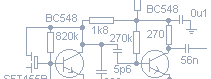
det går väldigt enkelt att ta en 4093 och koppla den som att den ger en signal några sekunder efter att man nollar en ingång
Re: Hjälp med summer till timer.
Hmm, har totalt hjärnsläpp för tillfället. Du har inte ork att berätta hur du tänkte en koppling där??
-
prototypen

- Inlägg: 11122
- Blev medlem: 6 augusti 2006, 13:25:04
- Ort: umeå
Re: Hjälp med summer till timer.

Protte
Senast redigerad av prototypen 24 januari 2010, 18:37:10, redigerad totalt 1 gång.
Re: Hjälp med summer till timer.
Underbart... Jag tackar och bugar så mycket. När tittar på det ser det ju ganska logiskt ut men det stod helt stilla innan!
Uppskattar verkligen er hjälp!!!
Nu ska det kopplas upp på kopplingsplatta och se om det funkar i praktiken också!
Uppskattar verkligen er hjälp!!!
Nu ska det kopplas upp på kopplingsplatta och se om det funkar i praktiken också!